
– Continuing our occasional history series, we look back to Whāingaroa a century ago – 1926 (part 4)
By John Lawson
Footbridge opened across Opotoru estuary
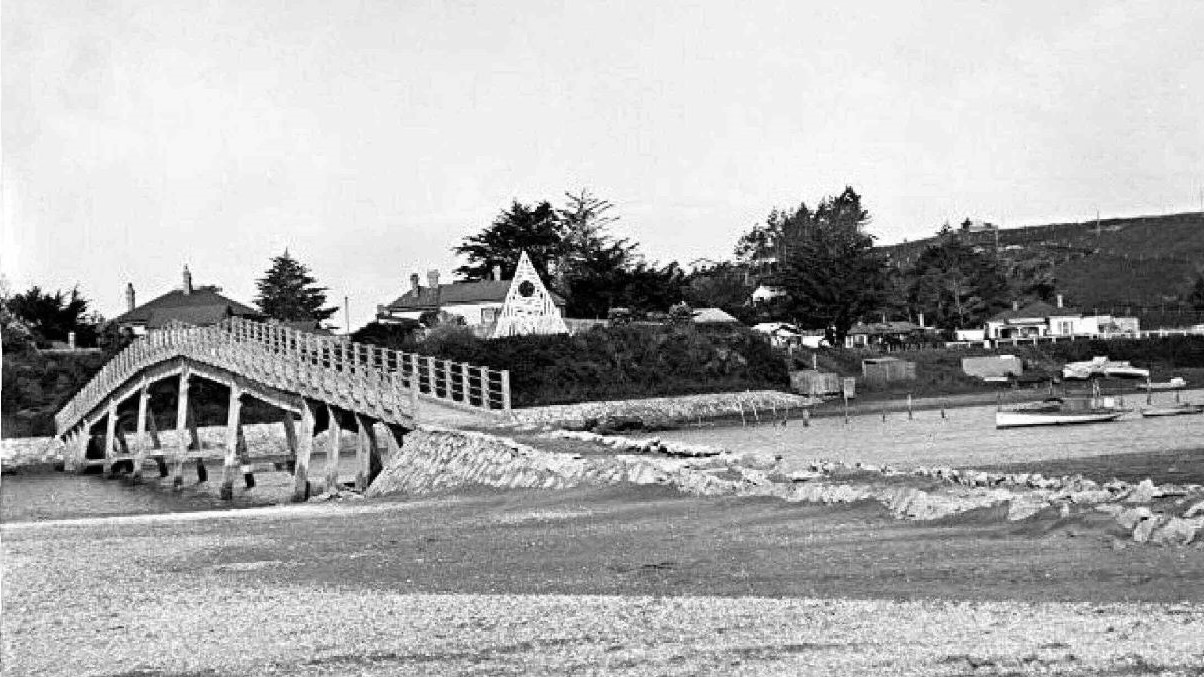
Richard Bollard formally opened the 320 feet, long and 6 feet wide ferroconcrete footbridge, 15 feet above high water, on Saturday 15 May, though it had been in use since the previous Christmas. It was designed by Adams and Jones, Auckland, and built by A Jane, Hamilton. O R Farrar was the supervising engineer. In his ‘Raglan’ book, Bob Vernon wrote, “Unfortunately costs were cut — the foundations were insufficient — it was really built on sand, and that parable is well known to us all. Also salt water and black sand used for mixing with the cement, accelerated the rust problem. It was not many years before chunks of concrete flaked off the piles, leaving the rusting reinforcing exposed to the elements. In 1947, about 18 years after it was built, Council had stripped down the bridge and attempted to patch it. It had not been successful. More reinforcing steel became exposed as concrete continued to flake off.” So the bridge was replaced in 1963 and again in 2011.
Prior to the opening, on 14 May, at a banquet given in the Town Hall, Thomas Parker, as chairman of Raglan Town Board, who had just won an election by 135 to Bill Lusty’s 91, spoke very highly of the MP and his promotion to Minister of Internal Affairs. Mr Bollard didn’t call it the Opotoro bridge, but said he had the honour to open the Kopua Bridge, because it passed over the Kopua Stream. Mrs. Parker cut the ribbon, Mr. Bollard declared it open and there was a welcome and a haka by about 30 Māori. Papahua was a name used on several maps, including the 1905 county map, but doesn’t seem to have been widely known in 1926.
Similarly, Makomako Native school had started on 26 October 1925, but Sir Maui Pomare, Member for Western Maori, officially opened it on 1 February, 1926, with Daniel Stewart Reid, MP for Waikato and Kawhia and Raglan county councillors, The opening at about 10.30am allowed them to travel by launch at high tide along the shallow Maari channel from Aotea harbour. Speaking in te reo Māori, the Minister said: “in addition to 11 native secondary schools and 8 native Mission schools, there are 125 native primary schools with a 1924 roll of 6,346. Average attendance in 1925 was 88.4% at native schools, but in European schools 90.6%.” The Education Department spent over £2,500 to open the school and made a further grant to level an acre as a playing ground. Makomako closed in 1984.
Karamu Caves, which were discovered about 1925, had some publicity in 1926 for an, “immense chamber with its great organ of pure white limestone, its domed roof, and wonderful acoustic properties.”
As usual there were several births, marriages and deaths and a couple of bankruptcies in 1926, including St. Alban’s Church, Waingaro with its first wedding on August 21, when Mary Parsons, of Tunaroa, Waingaro, married Thursby Whitfield, of Korakonui. However, by and large the trends of previous years continued.
For previous Sands of Time articles see – 1925, 1924, 1923, 1922, 1921, 1920, 1919, 1918, 1917 and pt 2, 1916, 1914, 1913, 1912, 1911, 1910