
By John Lawson
The most notable news in 1926 was probably the opening of the first bank (apart from the Post Office Savings Bank), but news reports were again dominated by social events, roads, who should pay for them and the frequent crashes on them. The footbridge and Makomako school had opened in 1925, but 1926 was when they were formally opened, the now long forgotten Camp Fergusson began, new golf clubs opened and weekly steamers and the dairy factory continued.
The 1926 census showed Raglan’s resident population as 302, including 36 Māori, a rather larger village than in 1911, when it was 246, but far smaller than the 3,717 of 2023.
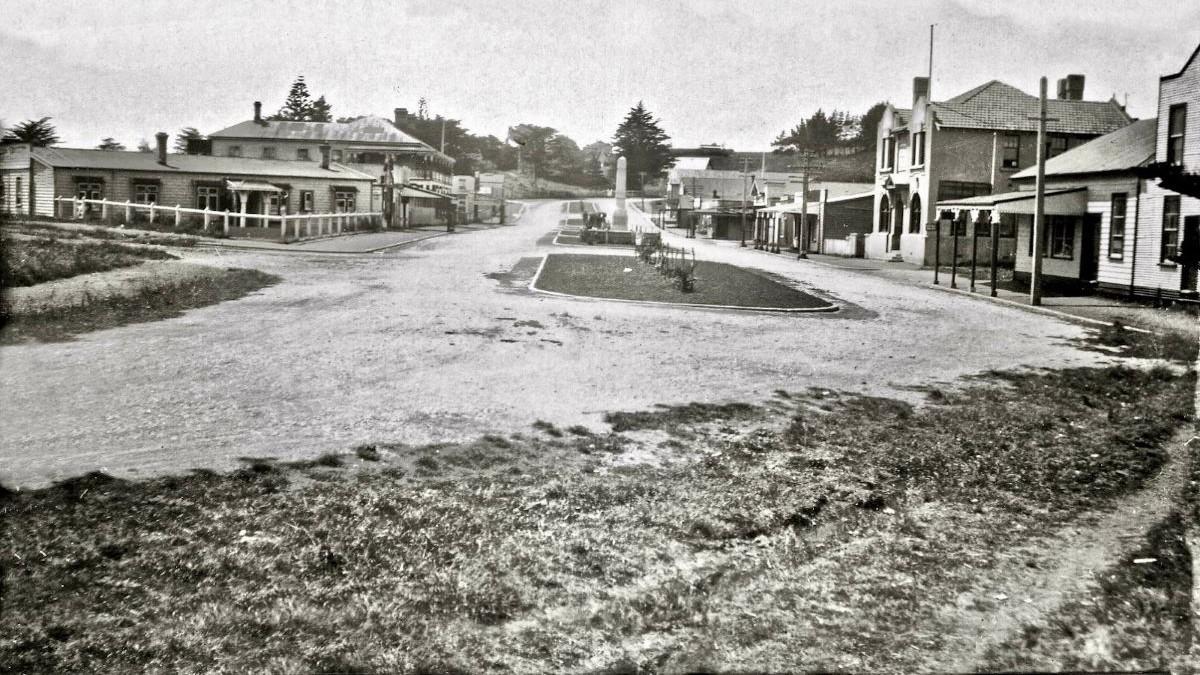
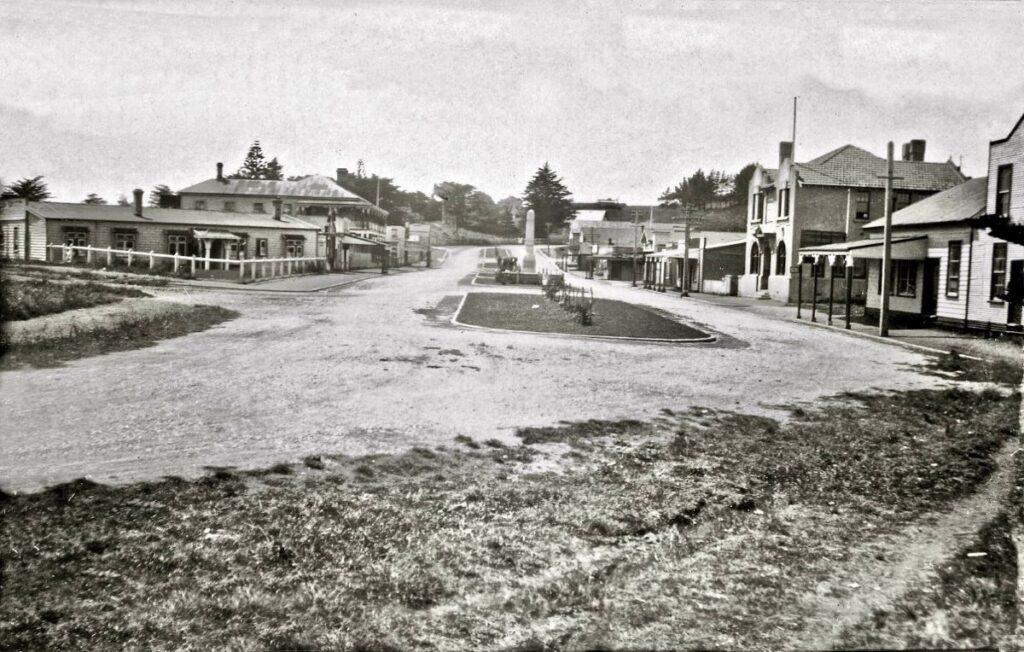
Bow St had lost most of its grass and been planted with phoenix palms in 1925.
At the annual meeting of the Raglan Co-operative Dairy Co, on 14 August, J.A.B. Hudson presented a petition, signed by nearly every tradesman in town, asking the directors to agree to support the first bank which opened a branch in Raglan. It’s not clear if it was coincidence, but 2 days later the Commercial Bank of Australia (CBA) announced it was going to open a Raglan Branch. Various changes later took place, including CBA and the Bank of N.S.W. amalgamating in October 1982 to form Westpac. After just over 90 years, Westpac closed in November 2016.
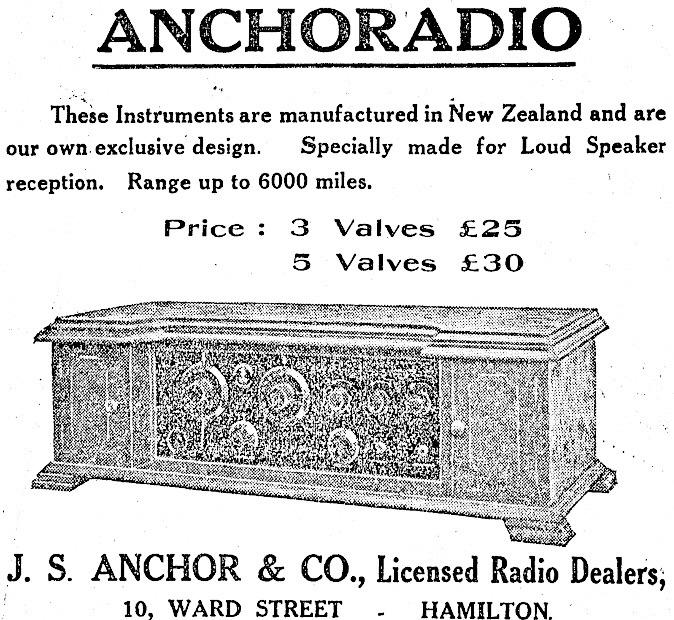
Although the first radio broadcast in the country was in 1921, George Anchor’s demonstration in the Town Hall on Saturday 12 June 1926, during a film interval and after the show, drew “a packed house”, to listen to San Francisco, Melbourne, Sydney, and Brisbane on a 5-valve set. “The loud burst of applause after the first few items drowned the remarks of the announcer, but afterwards the speeches given at the various stations were listened to with rapt attention until 11.30 p.m.” When Clem Beach put up his radio mast in 1929, he knew of only one other radio in Raglan. Median annual incomes ranged between £165 for a drover and £364 for a doctor, or animal trader (a much smaller range than today), so a £25 radio would have been more than most people earned in a month. Also mains electricity didn’t come until 1935, so a supply of batteries would have been needed.
Therefore newspapers remained the main source of information and musicians the main source of music, including the Raglan orchestra and Raglan Instrumental quartette, with frequent socials, concerts and dances. They included farewells to Te Hutewai School’s teacher, Miss Parker, Mr & Mrs E Langley, Mrs & Miss Bernard (on a trip to England), Mr E Sutton, moving to Dargaville post-office, Mr E Downs, manager of the Raglan Co-operative Dairy Co. moving to Te Puke Dairy Co, Mr & Mrs Alexander Baird, from the Harbour View Hotel and Mr. & Mrs. Ernie Orton Wallis moving to Green Lane, Auckland.
Aquatic sports, postponed from New Year’s Day due to weather, were held off the stone wharf on 29 January, followed by a concert and dance in the Town Hall. A greasy boom on the front of a dinghy was still part of the fun.
A concert and dance in Te Mata Hall raised money for the school picnic, later held at W. J. Saunders’ house. Raglan and Te Hutewai schools had their picnic in Kopua Park, Okete Sunday School had theirs on Okete beach and Waitetuna School Christmas party, races and games were in their adjoining paddock, followed by a high tea. Te Hutewai had a euchre party and dance in the school that night.
A concert, with piano and Japanese fiddle, and a dance for library funds was held in Te Uku Memorial Hall, the bachelors of Te Uku, Waitetuna and Okete had a ball there with the Raglan orchestra and dancing until 2 am and it was used for a Harvest Festival, followed by a musical social, the funds going to the Methodist Circuit. A musical evening in Raglan Congregational Church was also by the Raglan Orchestra, adding £5 to the parson’s car fund. A Squadron, 4th Waikato Mounted Rifles had a Hamilton jazz orchestra at their Town Hall ball, with dancing till after 3 am.
Raglan Golf Club held an evening dance in the Town Hall on the opening day of its new Lorenzen Bay course, making £3 for the club. Prior to 1914 golf had been played on the Somerset farm, Mangatawhiri Road, later owned by John Cleave, and on Albert Richard Langley’s farm at Lorenzen Bay. Two 9-hole clubs opened in 1926. The first was on 19 May at Kauroa and then in June, on Charles Ralfe’s farm, Lorenzen Bay. The first tee was where a P & T depot later stood, with the fairway parallel to the road and extending to Greenslade Rd. It was replaced about 1928 by a course on the farms of Bob and Frank Gibbison at Kauroa, later by the airfield and is now on Te Hutewai Rd.
Raglan Lawn Tennis Club continued to thrive, as did Okete, Te Mata, Te Uku and Waitetuna clubs. A social and dance in aid of the tennis club funds was held in Te Uku Memorial Hall on Friday, 22 October. In November Raglan tennis courts said they were an asset to the district, especially for summer visitors, yet paid £18 in rates. RCC decided to vote £5 a year to the club. A “Paddy’s Market” raised £45 for a children’s tennis court.
Raglan Horticultural Society’s annual show was reported as one of the most successful in the society’s history, the roses being particularly good and their patron, the Reform MP for Raglan, Richard Bollard, presented a silver cup for annual competitions. However, Raglan Agricultural and Pastoral Association, which had started in 1903, but had a poorly attended show in 1924, decided to remain dormant for a time and was never revived.