
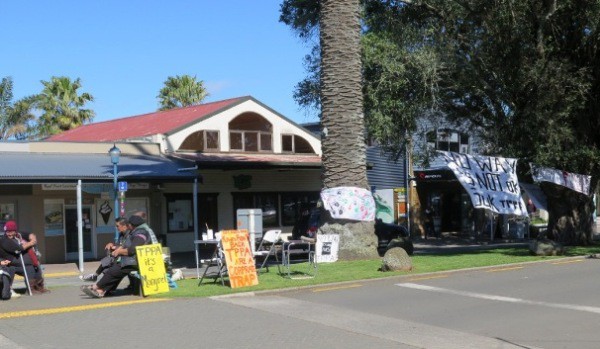
Raglanites put up placards in the centre of Bow St from 9am tomorrow on Saturday 10th September in support of the The Rally for Democracy in Auckland. John Lawson said they would be affirming our democratic rights and supporting initiatives to build a fairer and more sustainable society.
The placards were placed on the Bow Street central reserve strip opposite the Raglan Book & Gift shop. Placards slogans included, ‘TPPA is a Mongrel” and “No way, it’s not OK ” and visual placards represented many people with multi-coloured handprints. Supporters stayed at one of the crossing points to add their commitment.
Barry Coates, NZ coordinator of It’s Our Future and the Day of Action explained the motivation behind the rally: “This is a time when families are struggling with high housing costs, insecure work and stagnant wages. The gaps between the haves and have-nots are widening in our society. Our rivers and seas are being polluted, our native species are being wiped out and we are failing to curb climate emissions.”
“The government is allowing tax advantages for multinationals and the wealthy, and planning to privatise social services. They are ratifying the Trans-Pacific Partnership Agreement (TPPA) which would give new rights to foreign corporations to sue our government over democratically-agreed laws and policies, and override te Tiriti rights. Our peace-loving country is about to host an international weapons show and give licences for deep sea oil drilling. It’s time to call a halt. There are already too many advantages for corporations and the wealthy. We need to reclaim our rights.”
“Our Day of Action on 10 September is a protest. It is also an affirmation of our hopes and aspirations for a fair, just and sustainable society. We will highlight and celebrate the positive alternatives in communities in Aotearoa NZ, inviting participation from all those who are building a better future, whether through community housing, supporting refugees and the homeless, growing organics and working in community gardens, creating transport alternatives and community renewable energy, divesting from fossil fuels, or supporting community finance and local exchange schemes.”